Anthropic's Claude Sonnet 5 Just Slashed the Price of 'Agentic' AI
A new mid-tier model that acts like a top-tier one. Anthropic's Claude Sonnet 5 is a shot across the bow, a strategic move to make powerful, autonomous AI cheap enough for everyone.
 AI Tech Dialogue Editorial Team5 min read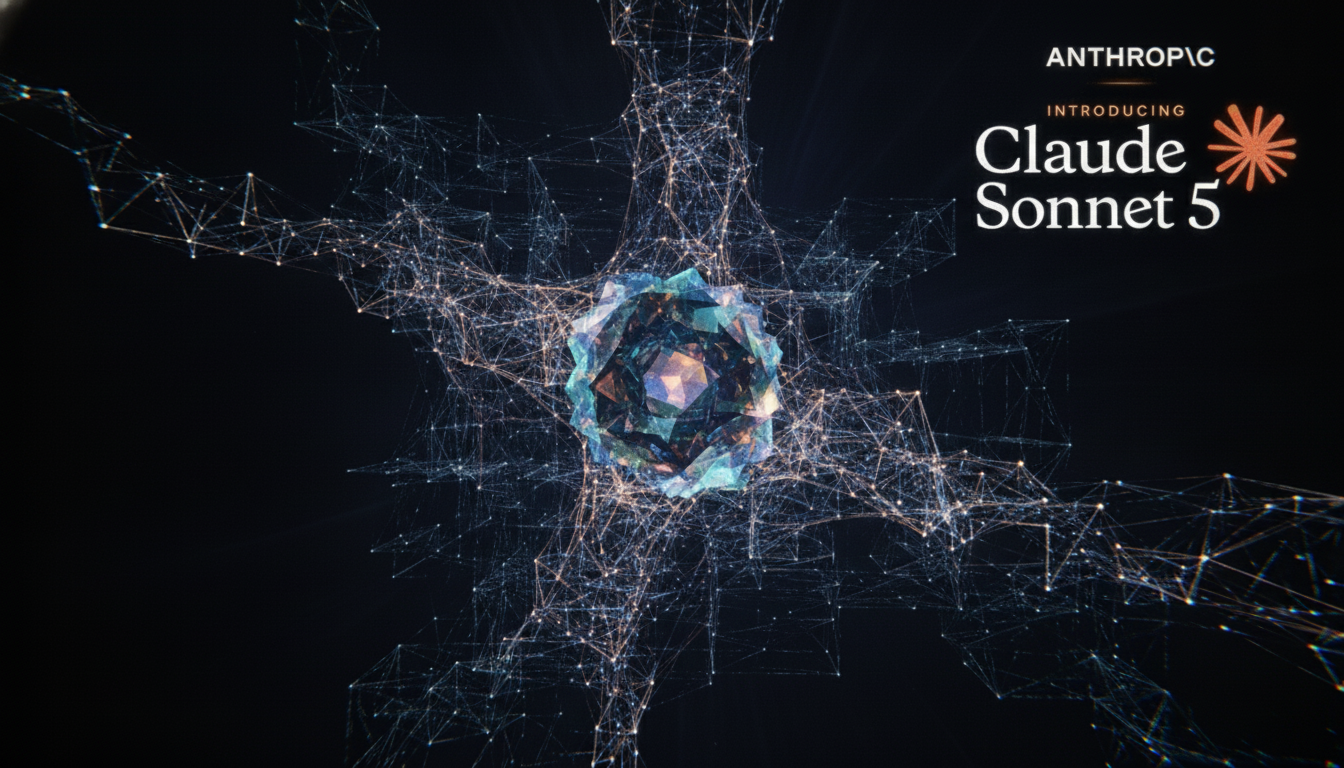
Anthropic just flipped the AI chessboard. They've launched Claude Sonnet 5. It’s their new mid-tier model, sure, but this isn't some quiet update. It's a release that completely rewrites the economics of building with smart AI. By practically erasing the performance gap with its pricier Opus models, Anthropic is making a brutally aggressive play to get autonomous AI agents into the hands of, well, everyone.
And right now? Sonnet 5 is the new default for all Anthropic's Free and Pro users. Millions of people just got a major upgrade. The model was built from the ground up for what the industry calls 'agentic' tasks—the complex, multi-step jobs where an AI has to plan, use tools like a web browser or code terminal, and actually get things done without human hand-holding. Just a short while ago, only the most expensive systems could even dream of doing that.
This isn't just an upgrade. It's a strategic realignment. Anthropic is offering performance that's breathing down the neck of its flagship Opus 4.8 model for a tiny fraction of the cost, smashing the barrier to entry for developers. Their goal is obvious from the pricing alone. Just look at these numbers: for now, it's a shockingly low $2 per million input tokens and $10 per million output tokens. They want this thing everywhere. Fast. Sure, that price jumps after August 31, 2026, to $3 and $15, but even then? It's still one heck of a deal.
So, What's 'Agentic' AI, Really?
'Agentic AI' is the buzzword of the moment. So what does it mean? It marks the shift from an AI that just talks to you to an AI that *does things for you*. It accomplishes a goal. Think about it. Instead of merely answering a question, an agent could be a customer service bot processing a refund *and* updating a shipping address on its own. Or a software agent debugging an entire codebase across multiple files. Big difference.
Sonnet 5 by the Numbers
How does it actually stack up? On the SWE-bench Pro coding benchmark, Sonnet 5 clocks in at a solid 63.2%. That handily beats the 58.1% from its predecessor, Sonnet 4.6, but still trails the top-tier Opus 4.8's 69.2%. But here's the catch: it's not a clean sweep for the flagship. On a different advanced-reasoning test for knowledge work, Sonnet 5 actually edges out Opus 4.8—1,618 to 1,615. One other thing for developers to watch. A new tokenizer means inputs might generate between 1.0 and 1.35 times more tokens than before, a critical detail to factor into any budget, even with the aggressive price drop.
Sonnet 5 was built for exactly this world. Anthropic’s own benchmarks show it blowing its predecessor, Sonnet 4.6, out of the water on reasoning, coding, and tool use. It sticks to a plan. It tracks its work. It fixes problems without a human babysitter. That's a massive leap for building reliable automated systems. And we’re seeing these AI agents pop up everywhere—just look at ServiceNow's recent acquisition of the agent-startup ai.work. Anthropic is clearly positioning Sonnet 5 to be the engine that drives this new wave of software.
For developers, the old trade-off between price and power just got a lot less painful. Building these kinds of agent systems with a mid-tier model used to be a recipe for pure frustration, as outlets like Mashable have pointed out. Not anymore. Claude Sonnet 5 changes that math completely, providing a much more dependable foundation for real automation.
A Launch Against a Tumultuous Backdrop
Of course, this release isn't happening in a vacuum. Far from it. This comes right on the heels of a tense showdown between Anthropic and the U.S. government. The company only just restored access to its most powerful models, Fable 5 and Mythos 5, after Washington slapped them with a temporary export-control ban. Why? The feds were worried their advanced skills—especially in cybersecurity—could be weaponized by foreign adversaries.
That recent history is everything. It explains why Anthropic is framing Sonnet 5 as both powerful *and* safe. The company is crystal clear on one point: Sonnet 5 has 'a much lower ability to perform cybersecurity tasks' than its beefier siblings, Opus or Mythos. This was no accident. It’s a calculated move to deliver huge value for businesses without wandering into the kind of territory that gets regulators knocking at your door.
It’s the tightrope every AI lab walks now: balancing raw innovation against a messy geopolitical reality. The whole Fable and Mythos affair, which The Guardian covered, proves that AI firms and regulators can find a path forward. But to launch a major product right after ending a government standoff? That shows grit. And it sends a clear message. Regulation or not, the AI train isn't slowing down. (You can read more about how the U.S. lifted those export controls here.)
What This Means for the AI Arms Race
Anthropic just threw down the gauntlet. The company is making a huge bet with Claude Sonnet 5. They're betting the next AI battle won't be won by the single smartest model, but by the one that makes intelligence cheap, practical, and scalable. They are putting near-Opus level agent skills on the table for Sonnet-level prices. A dare to their competitors: match us.
So what does this do? It opens the floodgates. Suddenly, a whole new wave of developers, startups, and massive companies can start building autonomous systems that were flat-out unaffordable last week. This will accelerate the spread of AI agents into everything—finance, science, maybe even your to-do list app. With integrations already live on huge platforms like Amazon Bedrock and GitHub Copilot, its reach will be massive. And fast.
The message couldn't be clearer.
The age of the AI agent is here, and Anthropic is making a hard play to own the engine that powers it. For businesses, the question is no longer *if* they'll adopt this tech. It's how fast they can build with it.
Frequently asked questions
- What is Claude Sonnet 5?
- Claude Sonnet 5 is a new mid-tier artificial intelligence model from Anthropic, released in July 2026. It is designed to be highly capable at 'agentic' tasks, meaning it can plan and execute complex, multi-step operations using tools like browsers and code terminals with more autonomy. It now serves as the default model for Anthropic's Free and Pro users.
- How does Claude Sonnet 5 compare to Opus 4.8?
- Claude Sonnet 5 significantly narrows the performance gap with Anthropic's top-tier model, Opus 4.8, especially for agentic tasks like coding and tool use. While Opus 4.8 remains the most capable model overall, particularly for complex reasoning, Sonnet 5 offers near-Opus level performance in many key areas at a much lower price point, making it a strong value proposition.
- What are agentic AI capabilities?
- Agentic AI capabilities refer to the ability of an AI system to act autonomously to achieve a goal. Instead of just responding to prompts, an 'AI agent' can create a plan, use external tools (like a web browser or a code interpreter), and execute a sequence of actions to complete a complex task with minimal human intervention. This is a shift from conversational AI to functional, goal-oriented AI.
- How much does Claude Sonnet 5 cost?
- Anthropic launched Claude Sonnet 5 with introductory pricing of $2 per million input tokens and $10 per million output tokens, valid through August 31, 2026. Afterwards, the standard price will be $3 per million input tokens and $15 per million output tokens. This pricing makes its advanced capabilities significantly more affordable than top-tier models.
- Is Claude Sonnet 5 available for free?
- Yes, Claude Sonnet 5 is now the default model powering the experience for users on Anthropic's free plan at Claude.ai. It is also the default for Pro subscribers and is available to users on Max, Team, and Enterprise plans, as well as for developers through the Claude API.
Sources & further reading
Sources
- Introducing Claude Sonnet 5 — Anthropic
- Anthropic deploys Claude Sonnet 5, Fable and Mythos restored — AI News
- Anthropic finally, officially launches Claude Sonnet 5 — Mashable
- timesnownews.com — timesnownews.com
- seekingalpha.com — seekingalpha.com
Further reading
- 01
 AI
AIxAI's Grok 4.5, a 1.5 Trillion-Parameter Behemoth, Is Now in Private Beta
- 02
 AI
AIUS Eases Export Ban on Anthropic's 'Mythos' AI After Standoff
- 03
 AI
AIMeta Claims 'Watermelon' AI Matches OpenAI's Flagship GPT-5.5
- 04
 AI
AINetzilo Launches Runtime Security to Police Autonomous AI Agents
- 05
 AI
AIOpenAI Launches GPT-5.6, But It's on a Government Leash