China's DeepSeek Forges Its Own AI Chip to Escape Nvidia's Orbit
Geopolitical pressure is forcing a radical new path for Chinese AI. The goal? Self-sufficiency. And it starts with custom silicon.
 AI Tech Dialogue Editorial Team6 min read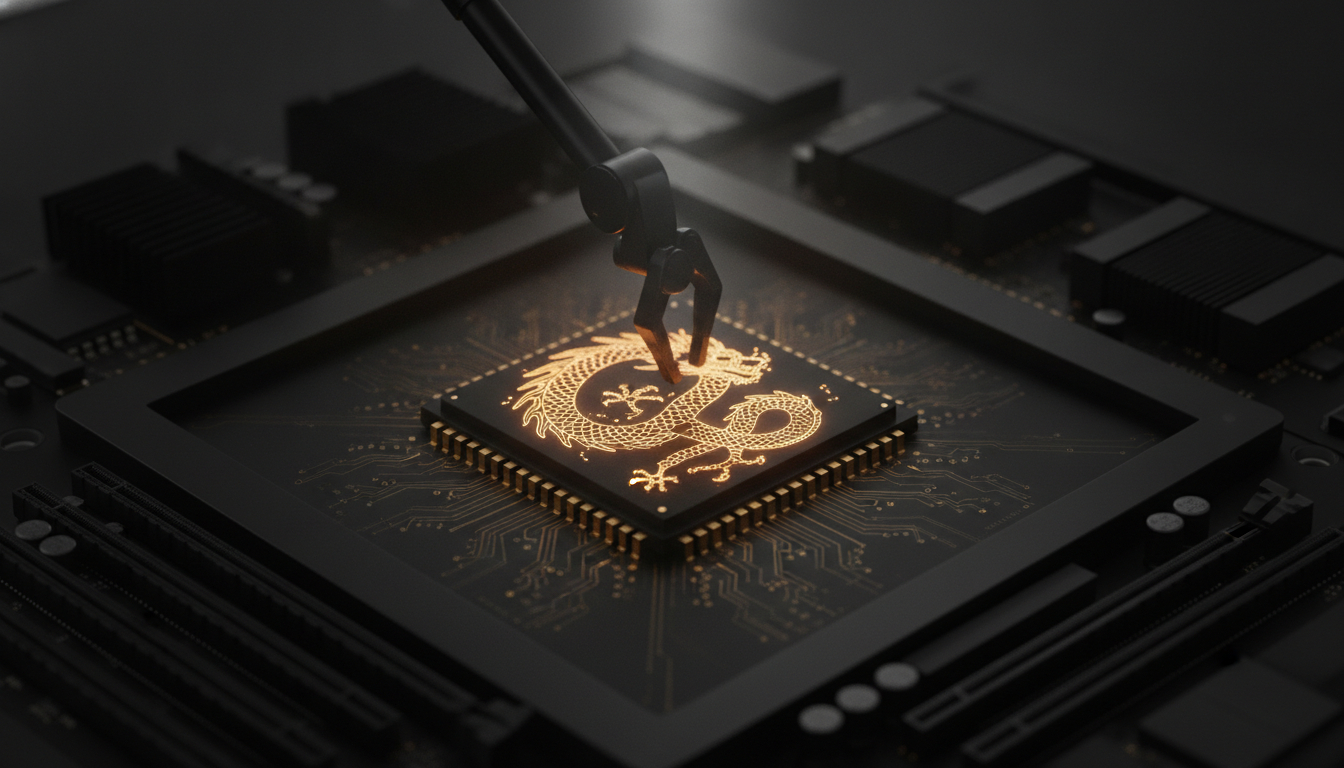
The Geopolitical Squeeze Driving Silicon Sovereignty
For years, the unspoken rule in artificial intelligence was simple. You bought your chips from Nvidia. The American giant’s powerful GPUs were the absolute bedrock of the AI revolution. But for Chinese companies, that bedrock is now dust. U.S. export controls, first rolled out in October 2022 and escalating ever since, are designed to hobble China's tech ascent by systematically cutting off access to the state-of-the-art processors needed to build and run advanced AI.
This is the vise grip that's forcing the hand of Hangzhou-based DeepSeek, one of China's most formidable AI startups. Their response? They’re developing their own custom DeepSeek AI chip. First reported by Reuters, this isn't just some strategic pivot. It's a declaration of independence. DeepSeek—known for its shockingly efficient models like DeepSeek-R1 and DeepSeek Coder—can't build a future on foreign hardware it might not be able to buy tomorrow. They played by the rules before, training models on Nvidia's H800, a chip neutered specifically for the Chinese market. Then Washington banned that one, too. The lesson was learned the hard way.
Sure, there's a domestic alternative. Huawei's Ascend AI accelerators have filled some of the void. But trading one dependency for another isn't a real strategy; it's just a different kind of lock-in. For a company as ambitious as DeepSeek, the only real path forward is to control its own silicon destiny. This is the new front in the global AI chip war. It’s no longer just about who has the best algorithms, but who commands the entire stack, from the model right down to the metal.
The Inference Imperative: Why Custom Chips Matter for Cost
Let's be clear. DeepSeek isn't trying to build a monster training GPU to rival Nvidia's best. No. Their focus is much smarter: a custom chip for AI inference. That's the process of running an already-trained model to get you an answer. It's a subtle distinction, but it reveals a deep understanding of AI economics. Training a model like GPT-4 costs a fortune, yes—hundreds of millions upfront. But that's a one-time hit. Inference is the real killer. It’s the relentless, continuous operational cost that scales with every single user query.
How much of a killer? Industry estimates suggest inference can account for a staggering 80% to 90% of a model's total lifetime compute bill. Every time you talk to a chatbot, generate an image, or ask for a line of code, an inference workload runs. For a popular service, those costs explode. This is where a bespoke chip changes the game. By designing its own hardware, DeepSeek can perfectly optimize it for the unique architecture of its own models, particularly its efficient Mixture-of-Experts (MoE) designs. This co-design approach—tuning the silicon to the software—can produce huge gains in efficiency and slash the cost per token. It's a raw power play to control the brutal economics of AI at scale.
A New Wave of Vertical Integration in China's AI Sector
And DeepSeek isn't alone. Its Beijing-based rival, Zhipu AI, is reportedly exploring its own chip development for the exact same reasons. A trend is emerging. China's most ambitious tech players now get it: true leadership demands vertical integration. The endgame isn't just building great models. It's about building the entire ecosystem to run them. They’re simply following the playbook written by American giants like Google with its TPUs and Amazon with its Trainium and Inferentia chips, who learned long ago that off-the-shelf hardware will only get you so far.
The project is young, reportedly starting about a year ago. DeepSeek has been quietly hiring chip designers and talking with foundries. But don't mistake 'early stage' for 'easy'. This is a monumental undertaking. Designing a competitive chip is brutally difficult and capital-intensive. Manufacturing it is even harder, especially when restrictions block access to advanced fabrication tech from firms like ASML. Still, the ambition is clear, and it aligns perfectly with Beijing's national strategy for a self-sufficient semiconductor industry.
Just look at the money pouring into the sector—video model maker Kling AI recently raised a $3 billion war chest. This is happening. For China's AI leaders, this push into custom hardware is the next logical step. A high-stakes gambit born of pure necessity. Will it challenge Nvidia's global dominance overnight? Of course not. But that's not the point right now. The point is to build a homegrown AI industry that can't be unplugged by Washington.
Frequently asked questions
- Why is DeepSeek developing its own AI chip?
- DeepSeek is creating a custom AI chip primarily to reduce its dependence on foreign suppliers like Nvidia, which has been impacted by U.S. export controls. This move also lessens reliance on domestic alternatives like Huawei. An in-house chip gives DeepSeek more control over the cost and performance of running its AI models, a strategy known as vertical integration.
- What is an AI inference chip?
- An AI inference chip is a specialized processor designed for running a trained artificial intelligence model to make predictions or generate outputs. Unlike chips for training, which teach the model, inference chips handle the day-to-day operational workload. They are optimized for efficiency and low latency, as they handle a high volume of user requests, which can account for up to 90% of an AI's lifetime computing costs.
- How do U.S. export controls affect Chinese AI companies?
- U.S. export controls, which began in October 2022, restrict Chinese companies from accessing advanced semiconductors and chip-making equipment, particularly high-performance GPUs from companies like Nvidia. This creates a significant bottleneck for Chinese AI firms, limiting the computing power they need to train and deploy the most advanced AI models and forcing them to seek domestic alternatives or develop their own hardware.
- Is DeepSeek the only Chinese company building its own AI chips?
- No, DeepSeek is part of a growing trend among leading Chinese tech firms. Competitor Zhipu AI is also reportedly exploring custom chip development. Larger companies like Alibaba and Baidu have also been working on their own AI processors for years. This reflects a broader strategic push within China's tech industry to achieve self-sufficiency in critical semiconductor technology.
Sources & further reading
Sources
- China's DeepSeek developing its own AI chip, sources say — The Straits Times
- DeepSeek moves toward its own AI chip — Jon Peddie Research
- DeepSeek and Zhipu AI Begin Self-Developing AI Chips — The Endgame Is No Longer Just Models — Pandaily
- effectivealtruism.org — forum.effectivealtruism.org
- wikipedia.org — en.wikipedia.org
- laweconcenter.org — laweconcenter.org
Further reading
- 01
 AI
AIMeta's Muse Spark 1.1 Is Here to Power AI Agents—And This Time, You're Paying
- 02
 AI
AIGoogle Cloud's AlphaEvolve Is Here to Invent New Algorithms
- 03
 AI
AIMistral AI Is Done With Just Language—Its New Robot Navigates With Only a Camera
- 04
 AI
AIOpenAI's GPT-5.6 Sol Arrives in ChatGPT After White House Review
- 05
 AI
AIAnthropic's New $965B Valuation Topples OpenAI