Mistral AI Is Done With Just Language—Its New Robot Navigates With Only a Camera
The French AI giant is jumping from the screen to the factory floor. Its new Robostral Navigate system gives machines eyes, letting them follow text commands with just a single camera—a move powered by a key acquisition.
 AI Tech Dialogue Editorial Team6 min read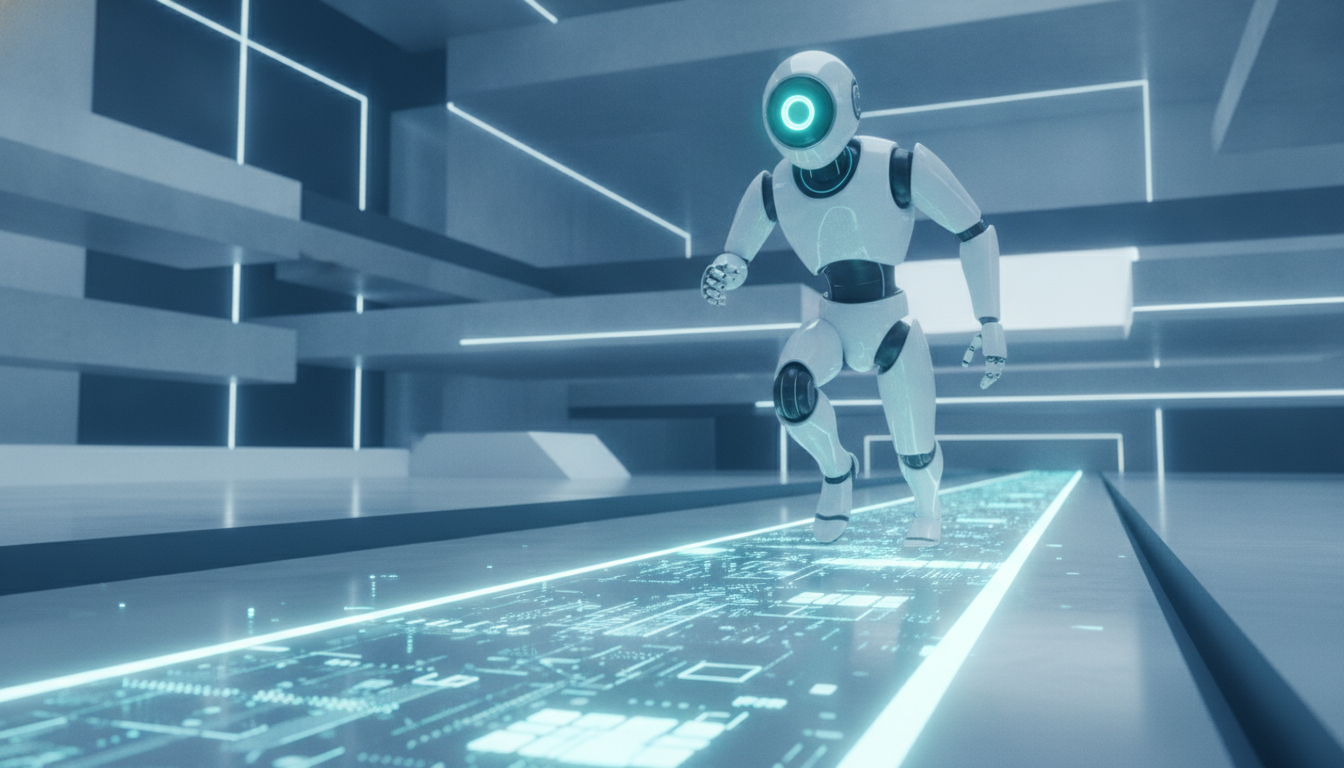
Mistral AI's Leap into Physical AI
Paris-based Mistral AI shot to the top of the language model world. Now it's leaving the screen behind.
The company just pulled the curtain back on Robostral Navigate, its first real leap into the physical world. It’s a system designed to guide robots through messy, complex spaces. The only inputs? A single, off-the-shelf camera and plain English commands. This is a massive expansion for the European AI champion, a jump into 'embodied AI' that could take its models from data centers to factory floors and warehouses.
Under the hood, it’s an 8-billion-parameter vision-language-action (VLA) model. What does that mean? It’s a specialized neural network that sees with a regular camera, understands a command like, "Turn right before the lockers and go to the orange sofa," and then figures out how to make the robot do it. It’s also hardware-agnostic. That means you can drop it onto almost anything that moves—wheeled, legged, or even flying robots—without a single tweak.
The Vision-Only Gambit: Ditching LiDAR
But the most disruptive part isn't what Robostral Navigate has. It's what it doesn't have.
Forget expensive, specialized sensors. No LiDAR. No depth cameras. Mistral is betting big on vision-only navigation, a move that could slash the cost and complexity of deploying robot fleets. Sure, LiDAR is precise, but it can cost thousands of dollars per unit. A huge barrier. A standard camera? Maybe a few hundred bucks.
That kind of hardware simplification could completely reshape logistics, manufacturing, and delivery. And Mistral's benchmarks suggest the bet is paying off. Big time. On the standard R2R-CE (Room-to-Room in Continuous Environments) test for navigating new spaces, Robostral Navigate nailed a 76.6% success rate. The company says that smokes the next-best single-camera system by 9.7 percentage points. Even more impressive? It apparently beats the top system using expensive LiDAR or depth sensors by 4.5 points.
A Strategic Pivot, Years in the Making
This wasn't some isolated experiment. Robostral Navigate is the public face of a very deliberate pivot, one signaled by Mistral's quiet acquisition of Austrian startup Emmi AI back in May 2026. Emmi AI lives and breathes 'Physics AI,' using intelligent models to simulate brutally complex industrial and engineering processes. That deal brought more than 30 specialized researchers under Mistral's roof and created a new industrial AI hub for the company in Linz, Austria.
At the time, Mistral CEO Arthur Mensch said the deal was about locking in the company’s leadership for high-stakes industries like aerospace and automotive. Makes sense. They already have deals with giants like Airbus and BMW. And here’s where the Emmi AI expertise really shines: Robostral Navigate was trained entirely in simulation. We're talking 400,000 trajectories across 6,000 virtual worlds. This simulation-first strategy also accelerates everything, with Mistral reporting that its clever training techniques crush development time from months down to mere days.
"This strategic acquisition cements Mistral AI's leadership in industrial AI and positions us as the partner of choice for manufacturers in high-stakes sectors like aerospace, automotive, or semiconductors," Mensch said in a May 2026 statement regarding the Emmi AI deal.
How It Works and What Comes Next
So how does it actually work? Mistral calls the technique 'pointing-based navigation.' Instead of crunching distances in meters and feet, the model simply predicts where it needs to go as a set of coordinates within the camera's own image. It's a clever approach that makes the system resilient to different types of camera hardware. It's the foundation for what Mistral hopes will be a unified agent for artificial intelligence in the physical world.
They aren't stopping there. Mistral is already boosting performance with online reinforcement learning—letting the AI learn from its own mistakes in real time. It's already working. As the model gets smarter, it opens the door to far more complex jobs. Think object manipulation. Multi-step industrial workflows. Of course, competitors like Google DeepMind and OpenAI (through its partnership with Figure AI) are pouring money into robotics. But Mistral’s laser focus on a cheap, vision-only, hardware-agnostic platform could give it a serious edge in the industrial world.
No word on pricing yet. Or a release date. But with deep industrial ties in Europe and a technology that attacks the biggest cost-barrier in robotics head-on, this feels like more than a product launch. It's a declaration. The AI race is officially leaving the server rack and getting its hands dirty in the real world.
Frequently asked questions
- What is Robostral Navigate?
- Robostral Navigate is the first robotics model from French AI company Mistral AI. It is an 8-billion-parameter vision-language-action (VLA) model that allows robots to navigate complex environments using only a single standard RGB camera and natural language instructions, without needing expensive sensors like LiDAR.
- How does Robostral Navigate work without LiDAR?
- The model uses a technique called 'pointing-based navigation.' It analyzes the video feed from a single camera to understand its surroundings and predicts target locations as coordinates within the image. This vision-only approach bypasses the need for LiDAR or depth sensors, which significantly reduces hardware cost and complexity.
- What is a Vision-Language-Action (VLA) model?
- A Vision-Language-Action (VLA) model is a type of AI that integrates three modalities: vision (what it sees), language (what it's told), and action (what it does). It processes visual input and text-based commands to directly output physical actions for a robot, creating a unified system for perception, reasoning, and control.
- Is Robostral Navigate better than systems that use LiDAR?
- According to Mistral AI, Robostral Navigate achieved a 76.6% success rate on the R2R-CE benchmark for unseen environments. The company states this performance is 4.5 percentage points higher than the best-performing system that uses more complex sensors like LiDAR or multiple cameras, suggesting a significant performance advantage despite using simpler hardware.
- Why did Mistral AI acquire Emmi AI?
- Mistral AI acquired Emmi AI, a startup specializing in Physics AI and industrial simulation, in May 2026. This strategic move was to bolster Mistral's capabilities in industrial AI and accelerate its entry into physical AI. Emmi's expertise in simulation was crucial for training Robostral Navigate efficiently in virtual environments.
Sources & further reading
Sources
- Mistral AI Turns Heads With First-Ever Robotics Model — TipRanks
- Robostral Navigate: single-camera AI navigation — Mistral AI
- investing.com — investing.com
- pulse2.com — pulse2.com
- pymnts.com — pymnts.com
- gigazine.net — gigazine.net
Further reading
- 01
 AI
AIOpenAI's GPT-5.6 Sol Arrives in ChatGPT After White House Review
- 02
 AI
AIAnthropic's New $965B Valuation Topples OpenAI
- 03
 AI
AIOpenAI's GPT-5.6 Family Is Here, After a Tense US Government Review
- 04
 AI
AIMeta's Muse Spark 1.1 Is Here to Build Your Next AI Agent
- 05
 AI
AIGrok 4.5 Is Here. And It's Aimed at Your Wallet.