Walden Robotics Erupts From Stealth With $300M for AI Factory Labor
Backed by Toyota and NVIDIA, the startup just hit a $1.1 billion valuation with a radical plan to deploy general-purpose AI robots that actually learn on the job.
 AI Tech Dialogue Editorial Team6 min read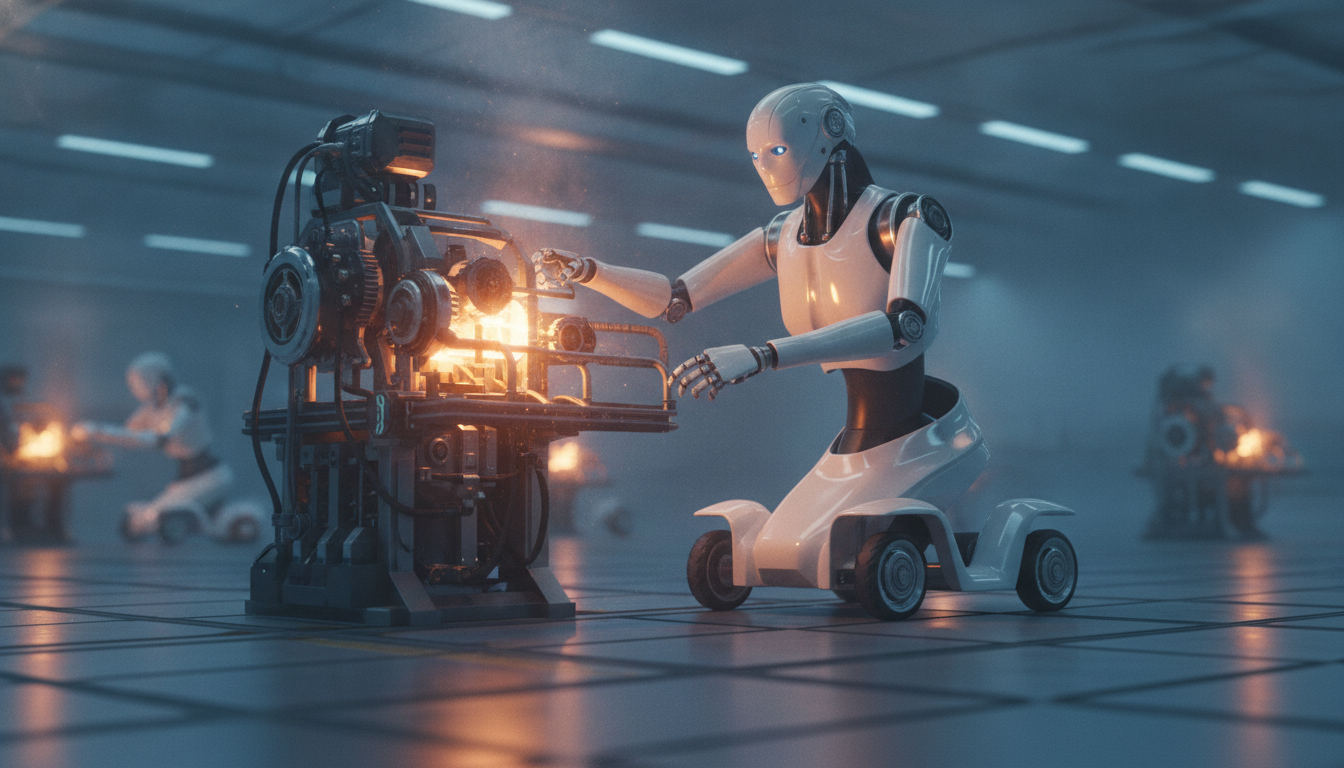
Meet the newest robotics unicorn. It's already working. Walden Robotics just shattered the venture capital playbook, blowing past a quiet seed round to launch out of stealth with a staggering $300 million war chest. That funding, co-led by industrial heavyweight Toyota and Deviation Capital, values the Cambridge, Massachusetts, startup at a jaw-dropping $1.1 billion. Its mission is to unleash fleets of general-purpose AI robots that can handle complex manufacturing and logistics, getting smarter with every single shift.
Forget the demo videos and research papers. This is real. Walden is a full-stack robotics company—founded by pioneers from the Toyota Research Institute (TRI), MIT, and Amazon—that has already escaped the lab. The company says that since spinning out of TRI in January 2026, its robots have been doing actual production work at a Toyota plant in North America. They went from pilot to live deployment in under two months. A blistering pace for an industry that's used to integration cycles taking years.
What Are Large Behavior Models?
For decades, factory robots have been brutes. Powerful, sure, but dumb. They just repeat one meticulously programmed task, forever. Caged for safety, blind to their world, unable to adapt. Walden wants to tear down those cages.
The intelligence driving its machines is something it calls Large Behavior Models (LBMs). Think of them as the physical cousins to the Large Language Models that power AI chatbots.
But LBMs don't learn by scraping the internet. They learn by watching and *doing* physical work. This approach, built on a decade of research into concepts like Diffusion Policy, allows Walden's robots to generalize from one task to another and continuously improve. They aren't programmed; they're trained. And that's a huge deal. It means they can handle the messy reality of a factory floor, where a part is never in the exact same spot twice. For companies struggling with labor shortages, this adaptability is the holy grail—a fundamental shift from rigid automation to dynamic problem-solving, a topic explored in our guide on how to fine-tune an AI model.
A Pedigree Forged in Industry and Academia
You don't just stumble into a $300 million seed round. Not without an unimpeachable team. Walden is led by CEO Dr. Russ Tedrake, a renowned professor at MIT who was also the Senior Vice President of Large Behavior Models at the Toyota Research Institute. His co-founders? A dream team of experts from TRI, MIT, Stanford, and Amazon. That's a powerhouse blend of top-tier robotics research, manufacturing excellence, and logistics on a planetary scale.
"Core advances in Physical AI, and all of the excitement and attention surrounding it, has made disruptive change possible," Tedrake said in a statement. But he quickly grounded the hype by stressing the importance of manufacturing's realities. "Providing real value to customers and building a robust and scalable business requires a deep understanding and respect for how manufacturing is done today." This pragmatism shows in their hardware. They've opted for a wheeled-humanoid robot designed for a factory's flat, structured environment, a clever move that sidesteps the immense stability and safety headaches of bipedal designs.
The $300 Million Wager on Physical AI
Look at the investor list. It reads less like a venture capital syndicate and more like a strategic alliance of future customers. Beyond Toyota and Deviation Capital, the round includes heavyweights like NVIDIA and Boeing, plus Samsung Ventures and Prologis Ventures, the investment arm of the world's largest warehouse owner. Infrastructure provider CoreWeave Ventures is in on the action, too.
This is smart money placing a massive bet that physical AI is ready for prime time. The investment signals that industrial leaders are done waiting for the technology to mature; they're actively funding its deployment now to secure a spot at the front of the line. The scale of this investment echoes the capital pouring into other AI sectors, like the defense industry, as seen with companies like Helsing. According to Bloomberg, this capital gives Walden a long runway to scale its tech and expand across the automotive, aerospace, and electronics industries.
The Road Ahead: Automation, Jobs, and the Future of Factories
Walden's robots are already on the floor, tackling tasks like machine tending, parts kitting, and assembly. The immediate goal is to augment human workers, taking on the "dirty, dull, and dangerous" jobs that are so hard to fill. But the launch of a player this well-funded inevitably raises big questions about the future of human labor. The conversation is shifting from *if* automation will impact jobs to *how* businesses can manage the transition, a key concern for leaders navigating AI automation vs. human jobs.
For its part, Walden emphasizes a human-centric approach. Hiroki Nakajima, CTO of Toyota Motor Corporation, framed the partnership in these terms: "Walden's uniqueness is its ability to deliver robots that provide value from day one...while always keeping people at the center." This philosophy, reflecting Toyota's own principles of continuous improvement (kaizen) and respect for people, points toward a future of collaboration. A future where robots handle repetitive physical work, freeing up human ingenuity for more complex problem-solving.
The company is entering a market with immense pent-up demand. But the road ahead isn't easy. Walden faces huge challenges in safety certification, integration with legacy systems, and maybe toughest of all, building trust with the human workforce. Yet with $300 million in the bank and a direct line into the world's most advanced factories, Walden Robotics isn't just theorizing about the future of work. It's building it. One task at a time.
Frequently asked questions
- What is Walden Robotics?
- Walden Robotics is a physical AI company, spun out of the Toyota Research Institute, that is building and deploying general-purpose robots for industrial work. The company launched in July 2026 with $300 million in seed funding and a valuation of $1.1 billion. Its robots are designed to learn and improve while performing tasks in real-world manufacturing and logistics environments.
- What are Large Behavior Models (LBMs)?
- Large Behavior Models are the core AI technology used by Walden Robotics. Similar to how Large Language Models learn from text, LBMs learn from observing and performing physical actions. This allows the robots to move beyond rigid, pre-programmed instructions and adapt to variations in their environment, enabling them to handle a wider range of tasks on a factory floor.
- Who invested in Walden Robotics?
- Walden Robotics' $300 million seed round was co-led by Toyota and Deviation Capital. The round also saw significant participation from strategic investors including NVIDIA, Boeing, Samsung Ventures, Prologis Ventures, and CoreWeave Ventures, alongside several financial partners. This investor group includes potential major customers and key technology suppliers for the robotics industry.
- Are Walden's robots already being used?
- Yes. According to the company, its general-purpose robots have been performing useful work in a Toyota production plant in North America since February 2026. They are capable of tasks such as machine tending, tool setting, parts kitting, and assembly. This rapid deployment is a key differentiator for the company, moving it from a research concept to a commercial reality.
Sources & further reading
Sources
- Walden Robotics Launches with $300 Million to Put General-Purpose Robots to Work Today — Automation.com
- businesswire.com — businesswire.com
- aiweekly.co — aiweekly.co
- moomoo.com — moomoo.com
- youtube.com — youtube.com
Further reading
- 01
 Startups
What Investors Look For in a Pitch (and What They Ignore)
- 02
 Startups
The Startup Pivot: It's Not Failure, It's Your Strategic Advantage
- 03
 Startups
Building in Public: The Founder's High-Wire Act of Radical Transparency
- 04
 Startups
How to Test a Startup Idea Before It Kills Your Paycheck
- 05
 Startups
The Co-Founder Question: Do You Really Need One?