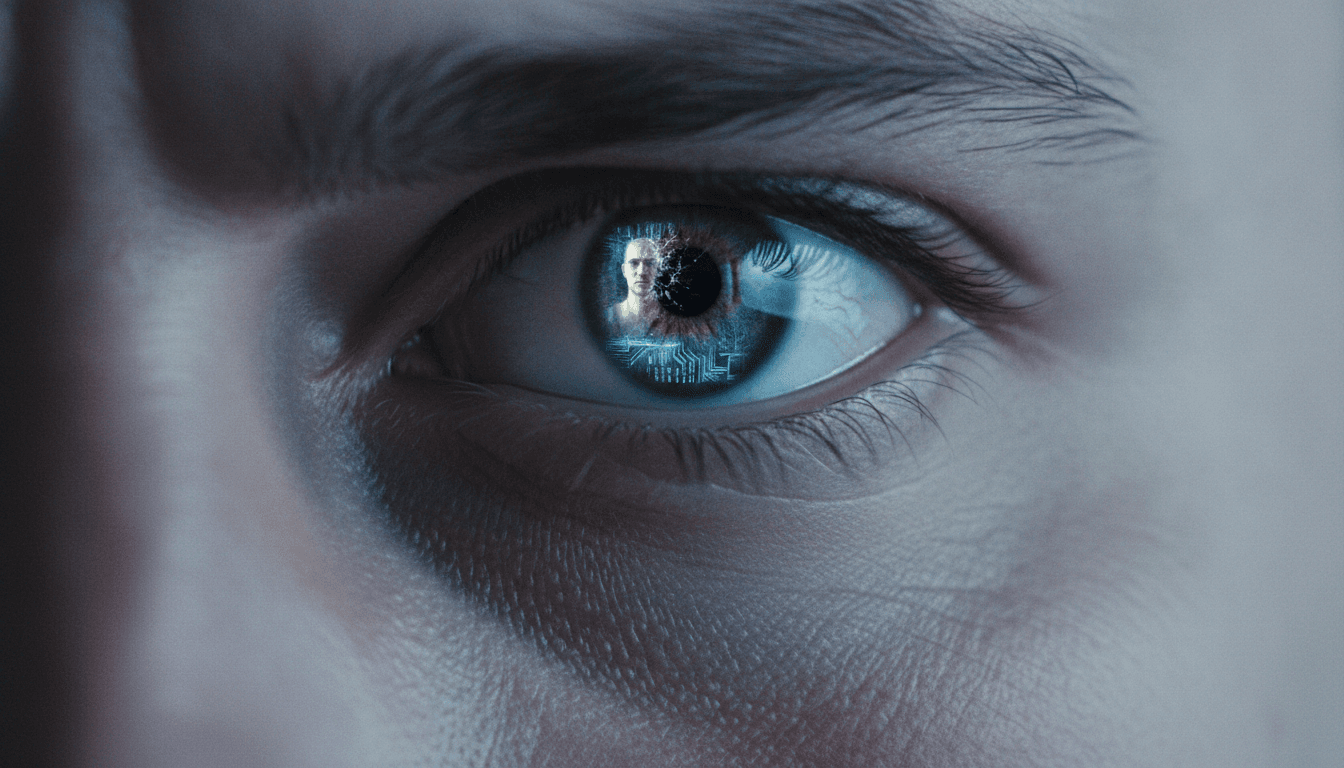
What Is Computer Vision? Inside the AI That Teaches Machines to See
It's in your phone and in self-driving cars. AI is learning to see the world. Here's how computers translate a flood of pixels into actual recognition.


It happens in a flash. You see a photo and—that's your friend. You spot a red octagon and hit the brakes for a stop sign. Effortless, right?
For us, yes. But for a machine, that simple act of seeing is a monumental task. Welcome to the world of computer vision, the field of AI dedicated to teaching computers how to interpret images and videos just like we do.
So, what is computer vision? It's a translation job. It’s about converting the messy, analog world into something a computer can process. A machine doesn't 'see' a cat. It sees a massive grid of pixels, just numbers representing colors. AI image recognition is the magic that teaches an algorithm to find the patterns in those numbers—the specific pixel arrangements that scream whiskers, ears, and fur—and slap the correct label on it: "cat."
And this isn't some far-off lab experiment anymore. It's everywhere. A Mordor Intelligence report projects the market will explode from \$27.39 billion in 2025 to \$68.38 billion by 2031. Why? Because it’s being built into everything from manufacturing lines (the biggest share) to cars (the fastest-growing part).
How Does Computer Vision Work? The Journey from Pixels to Insight
You can't just show a computer a picture. Teaching a machine to see is a complex pipeline, with the real work happening between the camera click and the final decision. That work is powered mostly by deep learning.
Think of it in three main stages.
- Image Acquisition: First, you need data. A sensor—say, the camera in your phone or mounted on a car—grabs an image or video feed. That's the raw material.
- Data Processing: Here's the heavy lifting. The system chews on that data with specialized algorithms. The undisputed star of the show today is the Convolutional Neural Network (CNN), a deep learning model that mimics the human brain's visual cortex. A CNN effectively guts the image, breaking it down into basic features like edges, textures, and colors by running it through a series of digital 'filters.' Each filter, or layer, looks for something different. The first layer might spot simple lines. The next combines those lines into shapes. The next looks for patterns, until a final layer can confidently identify a complete object.
- Analysis and Decision-Making: Once the CNN has digested the image, the system can finally *do* something. It might classify the whole scene ("beach"). Or it could find specific things inside the image, drawing boxes around them ("car here, pedestrian there"). It can even perform segmentation, figuring out exactly which pixels belong to the person versus the sidewalk.
Here's the catch. None of this works without training. Lots of training. Before a model knows a cat, it needs to see hundreds of thousands—sometimes millions—of photos all labeled "cat." By gorging on this data, the neural network slowly learns which pixel patterns mean what, getting more accurate with every image.
Real-World Computer Vision Examples: From Your Phone to the Freeway
This isn't sci-fi. It’s a real technology that's already changing daily life and entire industries. You probably use it dozens of times a day without a second thought.
In Your Smartphone
Your phone is ground zero for computer vision. That Face ID unlock? It’s mapping your unique facial features. Portrait Mode, with its artsy background blur, uses image segmentation to tell the difference between you and the wall behind you. It’s even working before you press the shutter, analyzing the scene to tweak the camera settings or wait until everyone's eyes are open in a group shot. It's a huge leap. As Samsung put it when discussing its Exynos processors, mobile cameras are becoming "intelligent systems capable of recognizing scenes and interpreting their semantic meaning."
In Your Car
Cars are a massive proving ground for this tech. Those Advanced Driver-Assistance Systems (ADAS) that keep you in your lane or brake automatically are powered by cameras. For self-driving cars, computer vision is everything. Companies like Tesla and Mobileye stitch together a 360-degree view of the world from a whole suite of cameras. Their algorithms have to instantly spot and classify everything—other cars, people, traffic lights, a rogue squirrel—to drive safely. It's a furious, nonstop dance of detection and prediction, all happening in milliseconds.
In Cameras All Around Us
Look beyond your personal gadgets and you'll see computer vision running all sorts of things. In a factory, a camera on an assembly line can spot a tiny defect no human eye could catch. In a retail store, it tracks foot traffic to help design a better layout. It's in hospitals, helping radiologists analyze X-rays and MRIs to find tumors. It's even in farming, where drones snap photos of fields to check crop health and see who needs water.
The Road Ahead: Challenges and Future Directions
But computer vision is hardly a solved problem. Far from it. These models can be surprisingly fragile. Throw in some bad lighting, a foggy day, or an object the AI has never seen before, and they can get confused. The sheer volume of labeled data needed for training is a huge bottleneck. And then there's the critical ethical question: how do we ensure that data is diverse and free of bias? Plus, good luck getting a straight answer on *why* a neural network made a specific call—explaining its logic is still a major research puzzle, not unlike the issues we cover in our piece on why AI chatbots hallucinate.
So what's next? More robust systems. Researchers are scrambling to build models that need less data to learn and don't get so easily tripped up by ambiguity. This technology is still young, but its impact is undeniable. As Jensen Huang, CEO of chipmaker NVIDIA, has said, "Artificial intelligence will be the most transformative technology of the 21st century." As that AI gets better at seeing, it will start to understand our world with a nuance that opens up possibilities we're only just starting to grasp.
Related Articles



This article was produced with AI assistance under human direction, and reviewed and fact-checked by a named editor before publication. How we work.
Frequently asked questions
- What is computer vision in simple terms?
- Computer vision is a field of artificial intelligence (AI) that trains computers to interpret and understand the visual world. Using digital images and videos, machines can identify and classify objects—like faces, cars, or text—and then react to what they 'see.' It's essentially giving computers the sense of sight.
- How is computer vision used in everyday life?
- You likely use computer vision daily. It powers facial recognition to unlock your smartphone, enables portrait mode in your camera, and helps self-driving cars identify pedestrians and traffic signs. It's also used in everything from medical imaging analysis to automated quality control in factories and security surveillance systems.
- Is computer vision the same as image recognition?
- Image recognition is a core component of computer vision, but they aren't exactly the same. Image recognition focuses on identifying and classifying objects or features within an image. Computer vision is the broader field that encompasses recognition as well as other tasks like object tracking, scene reconstruction, and motion analysis to build a more complete understanding of visual data.
- What is the main technology behind modern computer vision?
- The main technology driving modern computer vision is a type of machine learning called deep learning, specifically using models known as Convolutional Neural Networks (CNNs). Inspired by the human brain, CNNs are designed to automatically and adaptively learn spatial hierarchies of features from images, making them incredibly effective for tasks like object detection and classification.
Sources & further reading
Sources
- microsoft.com — azure.microsoft.com
- stanford.edu — hai.stanford.edu
- datacamp.com — datacamp.com
- roboflow.com — blog.roboflow.com
- databricks.com — databricks.com
- mordorintelligence.com — mordorintelligence.com