Build vs. Buy AI: A Decision Framework for Business Leaders
Build a custom AI, or buy one off the shelf? It's one of the biggest technology decisions a company can make. Here’s how to get it right.

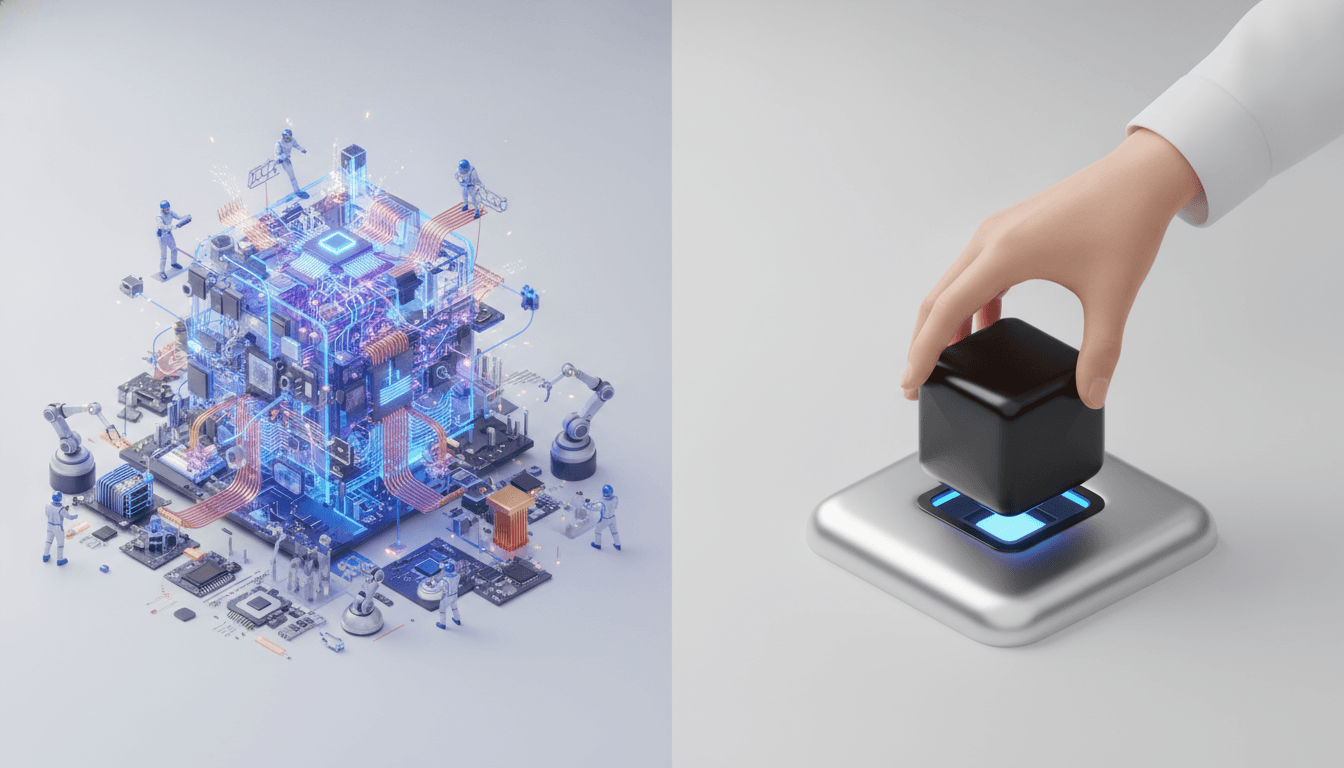
For business leaders, the question is no longer *if* they should invest in artificial intelligence. It’s *how*.
And that brings a monster of a strategic decision to the table. Build custom AI from scratch, or buy a pre-built tool? The answer changes everything. Budget. Time-to-market. Your entire competitive edge. This is not some simple technical choice—it's a brutal investment calculus that demands a hard look at where your company *really* stands.
The core tradeoff used to be dead simple. Control versus speed. Building your own AI meant maximum control, total customization, and a powerful proprietary asset nobody else had. Buying a SaaS product, on the other hand, gave you instant access to proven tech and slammed the accelerator on deployment. But that neat little binary choice is falling apart. Vaibhav Dani, CEO at Map Communications, argues that generative AI has completely shattered the old software procurement model. As he wrote for Forbes, "The question is no longer 'Do we build or buy?' but 'Where do we place our competitive differentiation in a rapidly commoditizing intelligence market?'"
The smartest play is now often a hybrid one. Buy to learn. Build to last.
When Does Building a Custom AI Make Sense?
Let's be blunt. Building your own AI is a massive commitment. We're talking time, talent, and a staggering amount of capital. Initial development for a custom solution can cost anywhere from $200,000 to over $1.5 million, with timelines stretching a grueling 12 to 24 months before you even see a full production deployment. So why on earth would anyone do it? Because under the right circumstances, it’s not just an option. It's essential.
If AI is Your Core Differentiator
The biggest reason to build? Simple. The AI *is* your competitive moat. Full stop. If you're creating something your rivals can't just copy by signing up for the same SaaS tool, a custom solution becomes non-negotiable. This is about building truly unique capabilities. These models, trained on your company's proprietary data and fine-tuned to your specific workflows, become a powerful, defensible asset—intellectual property that, done right, actually grows in value.
For Deep Customization and Data Control
Think about highly regulated industries. Healthcare. Finance. Defense. For them, building is often the default, because data security and compliance are everything. Building a custom model means your sensitive proprietary data never leaves your four walls, killing the risks of handing it to a third party. But there’s another thing. Off-the-shelf tools are built for the masses, which means they might be completely wrong for *you*. If your process is hyper-specialized—say, analyzing unique microscopic imagery, as one expert points out—a generic model will almost certainly fall flat on its face. Gartner backs this up, predicting that by 2026, over 80% of enterprises will be using custom AI models tuned for industry-specific language just to get the accuracy and compliance they need.
When You Have the Right Ingredients: Data and Talent
Your custom AI will only ever be as good as its data. That's the iron law. Before you even *think* about building, you need a bulletproof strategy for collecting, cleaning, and managing high-quality, relevant data. A shocking number of AI projects don't fail because the model is weak; they fail because the data infrastructure is a complete disaster. The good news? You might not need millions of records. For many AI agents, a mere 20 to 100 high-quality examples of a task done right is enough to get rolling. But data is only half the battle. You also need the right people. We’re talking a specialized team of data scientists, machine learning engineers, and MLOps experts. It's a huge, expensive lift. If you can't get that talent in the door, a custom build is probably off the table.
The Case for Buying Off-the-Shelf AI Tools
But what if AI isn't your core product? What if it's just a critical supporting role? In that case, buying is often the smarter, more efficient path. For a lot of businesses, vendor-supplied tools offer a much faster, more predictable, and often cheaper way in.
When Speed is the Top Priority
The biggest argument for buying is speed. Pure and simple. Building a custom model can devour a year or more of your life. A vendor solution? You could be live in *weeks*. A 2024 McKinsey report found that companies using pre-built AI tools slash their time-to-market by a staggering 50% compared to custom builds. In fast-moving industries, that kind of velocity is everything. Need to show quick wins and an immediate ROI? Buying is your ticket.
For Standard Use Cases and Limited Resources
Is the problem you're trying to solve a common one? Think fraud detection. Sentiment analysis. Basic customer service bots. If so, a vendor has almost certainly built a perfectly good solution for it already. As Phil Mui, an SVP of Engineering at Salesforce, bluntly puts it, "Why build something that can be bought?" Buying lets you skip the huge upfront capital expense for infrastructure and talent, swapping it for a predictable subscription fee. Suddenly, AI is on the table for smaller businesses and teams without bottomless pockets. You can find more detail in our guide to an AI strategy that actually delivers business value.
Managing the Total Cost of Ownership (TCO)
But here's the catch with buying. That cheap-looking sticker price can be a mirage. You have to analyze the Total Cost of Ownership (TCO) over several years, because SaaS AI vendors often charge per user or per interaction—and those costs can absolutely explode as you scale. Some analyses show SaaS wrappers charging up to 100 times the raw cost of the underlying model's computing power. One hundred times. That $100,000 AI software purchase? It can easily demand another $200,000-$400,000 in the first year alone just for integration, training, and compute resources. The breakeven point, where a custom build actually becomes cheaper, often hits between two and four years out. For many startups, the real tipping point is when their monthly API bills start creeping past $3,000-$5,000. It's a financial reality check that forces you to think way beyond the initial price tag, as this founder's guide to SaaS pricing explains.
The Hybrid Approach: A Middle Path
So, build or buy? It turns out that's the wrong question. It’s not a binary choice. A hybrid strategy is now the smartest path for most organizations. The approach is simple. Buy off-the-shelf tools for standard functions. Use them to get your feet wet, gain experience, and validate business cases. Then, you strategically build custom solutions only for the core processes that give you a real competitive advantage. This "buy to learn, build to last" progression lets companies hit a measurable ROI up to 60% faster than if they'd committed fully to one path from the start. And consider this: MIT research found that vendor-led AI implementations succeed about 67% of the time. Purely internal builds? Just 33%.
The decision comes down to a clear-eyed assessment of your strategy, your resources, and your timeline. No way around it. Are you building a core, differentiating capability that will define your market position for years? Or are you just trying to optimize an existing process with proven tech? Answering *that* question illuminates the right path forward. Perhaps the most important step is just to start, as this guide to customer service bots people don't hate shows.
Related Articles



This article was produced with AI assistance under human direction, and reviewed and fact-checked by a named editor before publication. How we work.
Frequently asked questions
- What is the main difference between building and buying AI?
- Building AI involves creating a custom solution in-house, offering maximum control, data privacy, and competitive differentiation, but it requires significant time, investment, and specialized talent. Buying AI means subscribing to a pre-built SaaS tool, which is faster to deploy and cheaper upfront, but offers less customization and creates vendor dependency. The choice hinges on whether AI is a core differentiator or a supporting function for your business.
- When is it better to build a custom AI model?
- You should build a custom AI model when it's core to your competitive advantage, you operate in a highly regulated industry requiring strict data control, or your use case is too unique for off-the-shelf tools to handle effectively. Building is also preferable if you possess proprietary data that can create a powerful, defensible asset. However, this path requires substantial investment in both expert talent and high-quality data infrastructure.
- Is it cheaper to buy an AI solution than to build one?
- Buying an AI solution is generally cheaper in the short term, as it avoids high upfront costs for development, infrastructure, and hiring specialized talent. However, the long-term total cost of ownership (TCO) can be higher due to recurring subscription fees that scale with usage or user count. A custom-built solution has a higher initial investment but can become more cost-effective over a 2-4 year period, especially for high-volume applications.
- What is a hybrid approach to AI adoption?
- A hybrid approach combines both building and buying AI capabilities. Companies adopt this strategy by purchasing off-the-shelf AI tools for common, standardized tasks to achieve quick wins and learn about the technology. Simultaneously, they invest in building custom AI solutions for core business functions where they can create a unique competitive advantage. This 'buy to learn, build to last' model often provides the best balance of speed, cost, and strategic value.
Sources & further reading
Sources
- aidataanalytics.network — aidataanalytics.network
- g2techsoft.com — g2techsoft.com
- concordusa.com — concordusa.com
- greennode.ai — greennode.ai
- mynextdeveloper.com — mynextdeveloper.com