Intel Flips the Switch on ASML's High NA EUV, Igniting a New Chip War
Intel is officially the first to produce chips with ASML's revolutionary, $400 million High NA EUV lithography machines. It's a massive gamble to reclaim manufacturing supremacy.
 AI Tech Dialogue Editorial Team6 min read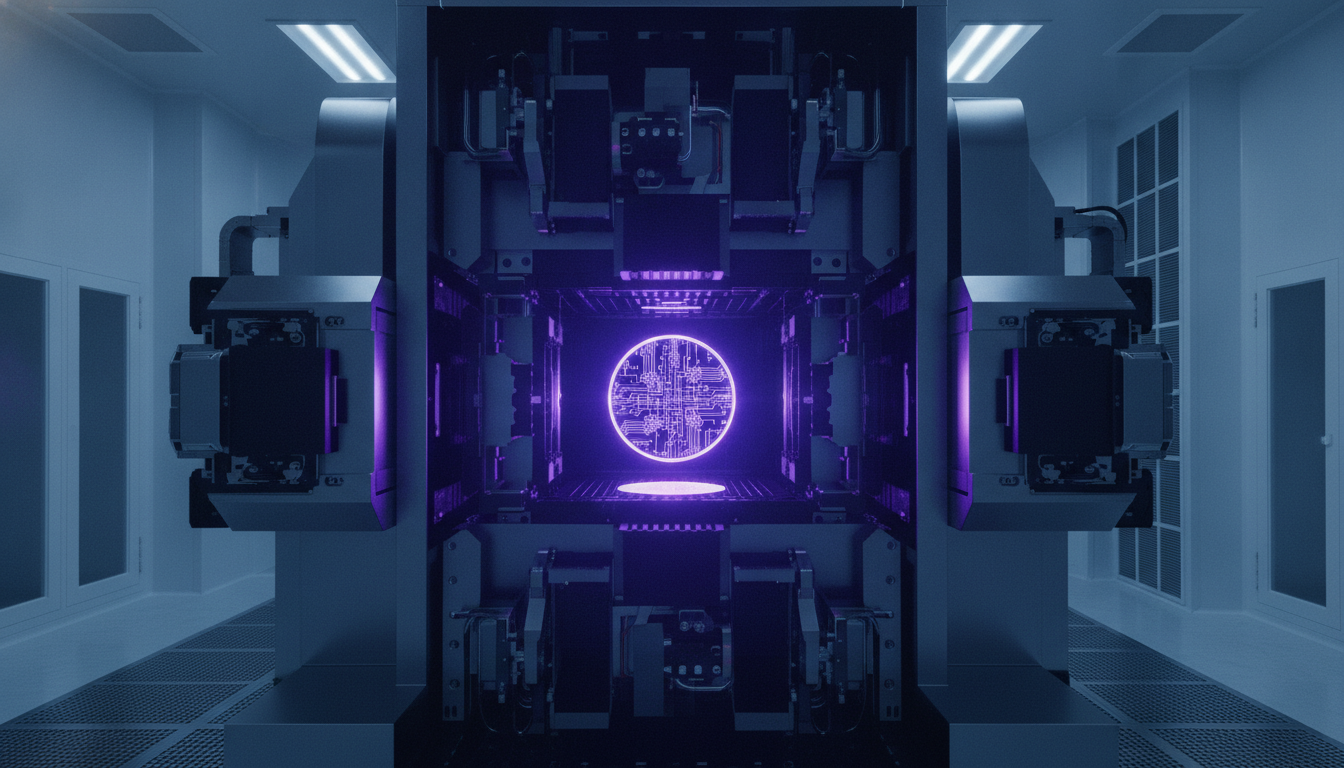
It’s happening. In a factory in Hillsboro, Oregon, Intel has flipped the switch, starting high-volume manufacturing with ASML's groundbreaking High NA EUV technology. This isn't some minor upgrade. It's a quantum leap in the physics of chipmaking. And Intel is betting its entire future on being the first to tame it.
The official confirmation came on July 15, 2026. In a joint announcement timed with ASML’s blockbuster earnings report, the two giants revealed that a subset of Intel’s Core Ultra Series 3 laptop processors—codenamed “Panther Lake”—are now rolling off the line using the world's most advanced lithography system. Built on Intel’s 18A process node, these are the first commercial logic chips ever made with High NA EUV. The tech is finally out of the lab and into the real world.
“This milestone reflects the close technical collaboration between Intel and ASML and shows how High NA EUV can be integrated into advanced semiconductor manufacturing at scale,” said Naga Chandrasekaran, Executive Vice President and General Manager of Intel Foundry.
What Is High NA EUV and Why Is It Such a Big Deal?
Chipmaking is, at its heart, a printing process. Just on an impossibly small scale. For years, the industry has leaned on Extreme Ultraviolet (EUV) lithography, an ASML-pioneered technique using light with a tiny 13.5-nanometer wavelength to etch circuits. High NA EUV is the next leap.
What’s ‘NA’? Numerical Aperture. It’s all about the angle of light the system’s optics can grab and focus. The new TWINSCAN EXE series machines crank up the NA from the old 0.33 to a much wider 0.55, allowing them to print features with a stunning 8-nanometer resolution. That means, according to ASML, printing features 1.7 times smaller. It means boosting transistor density by almost three times. Think of it as the difference between a fine-tipped pen and a surgical laser—and this is how the wild science of how semiconductors work keeps pushing forward.
“With increased resolution and better process control, the introduction of High NA EUV marks a substantial development in semiconductor lithography,” said ASML President and CEO Christophe Fouquet. That simplification he mentions is everything. Sure, rivals might get similar results with older EUV tools. But here's the catch: they’d need complex, costly multi-patterning techniques, zapping the wafer over and over. High NA promises a finer result in one clean shot. One efficient pass. That could mean fewer defects and faster production.
Intel's $400 Million Gamble to Reclaim the Throne
This move is CEO Pat Gelsinger's whole strategy in a nutshell. For years, Intel stumbled, falling behind rivals TSMC and Samsung. Gelsinger himself called their slowness to adopt the first generation of EUV a massive strategic error. Not this time. Intel was determined not to make the same mistake, becoming the first company to buy one of ASML’s next-gen machines when the first parts landed in its Oregon R&D facility in late 2023.
The investment is staggering. We're talking $380 to $400 million for a single machine. A machine the size of a double-decker bus. Intel has been installing and calibrating not just one, but two systems—the first-of-its-kind TWINSCAN EXE:5000 and the second-gen EXE:5200B—making it the technology's inaugural customer. Their clever move is dual-qualifying certain layers of the 18A process. This means they can produce the same chip on either the new High NA machines or their existing EUV tools, which ensures stability while they learn the ropes of the new platform. And the early results are in: Intel reports yields from High NA already match its mature tools. That's a huge early win.
Intel's all-in approach is a sharp contrast to its competitors. TSMC, the current market leader? They're sticking with existing EUV for their next few process nodes, pointing to the sky-high cost and unproven nature of the new platform. Samsung is only planning to install its first High NA tool for R&D later this year. That puts them about a year behind. This is Intel's window—a critical opportunity to master the tech and leapfrog them both.
The Chips of Tomorrow, Powering the AI Revolution
Yes, the first result is the Panther Lake Core Ultra Series 3 processor for laptops. But the implications are so much bigger. The power to etch smaller, denser transistors is absolutely fundamental to building the high-performance computers needed to fuel the AI boom. More transistors, more power. More specialized cores for AI. It's that simple. And it affects everything from your phone to the sprawling server farms that run generative AI. These advanced chips are the real engines of modern AI, rewriting the rules for how data centers work.
For now, Intel is only using High NA for specific layers on Panther Lake. But the long-term plan is to go much deeper, integrating it broadly into future nodes like the upcoming 14A process. What they're learning today in Oregon isn't just for today. It’s for tomorrow. Those lessons will directly shape the chips that won't even hit the market for another two or three years.
Intel's bet couldn't be clearer. By mastering the most complex, most expensive manufacturing tool ever built, they believe they can out-innovate everyone and reclaim their crown. The first chips are out the door. The race is on.
Frequently asked questions
- What is High NA EUV technology?
- High NA EUV is the next generation of extreme ultraviolet lithography used to manufacture microchips. Developed by ASML, it uses a higher numerical aperture (NA) optical system to project circuit patterns with much finer detail onto silicon wafers. This allows for the creation of smaller, denser, and more powerful transistors, which are the building blocks of modern processors.
- What is Intel using High NA EUV to make?
- Intel is the first company to use High NA EUV in high-volume manufacturing. It is currently producing a subset of its Core Ultra Series 3 laptop processors, codenamed 'Panther Lake,' on its 18A process node. This technology is critical for Intel's future roadmap, including its upcoming 14A process, to build more advanced chips for AI and high-performance computing.
- How much does a High NA EUV machine cost?
- ASML's High NA EUV lithography systems are among the most expensive single manufacturing tools ever created. Each machine, such as the TWINSCAN EXE series, costs approximately $380 million to $400 million. This high price tag is a major reason why its adoption by chipmakers is a significant strategic and financial decision.
- Why is High NA EUV important for AI?
- Artificial intelligence and machine learning applications demand enormous computational power. High NA EUV technology enables the creation of chips with significantly more transistors packed into the same space. This density allows for more powerful processing cores and specialized AI accelerators on a single chip, leading to faster and more energy-efficient performance for complex AI workloads.
- Are other companies like TSMC and Samsung using High NA EUV?
- Intel is the first to adopt High NA EUV for high-volume production. Its main rivals are taking a more cautious approach. TSMC has indicated it will stick with existing EUV technology for its next few nodes, citing the high cost of the new machines. Samsung is expected to install its first High NA EUV tool for research and development soon, placing it about a year behind Intel's production timeline.
Sources & further reading
Sources
- Intel starts using ASML's High NA EUV technology to produce chips — SiliconANGLE
- asml.com — asml.com
- tomshardware.com — tomshardware.com
- seekingalpha.com — seekingalpha.com
- overclock3d.net — overclock3d.net
- substack.com — marklapedus.substack.com
Further reading
- 01
 Technology
AI Is Rewiring the Developer's Brain
- 02
 Technology
AI in the Classroom: A Teacher's New Assistant?
- 03
 Technology
The FTC's New Warning to AI: Stop Steering Results in Secret
- 04
 Technology
Meta Sued: Did an Algorithm Fire Employees on Medical Leave?
- 05
 Technology
Perplexity vs. Google: Is the AI Search Revolution a Real Threat?