What Quantum Computing Actually Does in 2026 — No PhD Needed
It won’t replace your laptop, but it might invent your next life-saving drug. A no-jargon guide to what makes quantum computers different and where the real-world applications are hiding.

Let's get one thing straight. A quantum computer will not be running your browser or your video games. Not anytime soon. Your laptop is perfectly safe. But deep inside shielded, supercooled labs, a radically different kind of machine is learning to solve problems that would absolutely choke the world's most powerful supercomputers. This is quantum computing. And understanding it means you have to toss out a few basic ideas about how computers even work. So here it is: **quantum computing explained simply**, without the dizzying equations. A look at what it is, what it isn’t, and the strange future it promises.
Your computer, at its core, is a master of brute force. Everything comes down to bits. Think of a bit as a light switch—it's either on (1) or off (0). That's it. Every single email you send, every photo you take, is just a mind-bogglingly long string of these simple on/off commands. That system has served us incredibly well. But it has hard limits. For certain problems, like simulating the complex dance of atoms in a molecule, the number of possible states to check grows so astronomically large that a supercomputer the size of a planet would need billions of years to get it done.
Quantum computers don't just build a faster light switch. They reinvent the switch entirely.
The Quantum Difference: From Light Switches to Spinning Coins
So what's the secret ingredient? It's the 'qubit,' or quantum bit. A classical bit has to be a 0 or a 1. End of story. A qubit can be a 0, a 1, or—and here's the wild part—a weighted combination of both at the exact same time. This bizarre property is called superposition. Think of a spinning coin. While it's in the air, is it heads or tails? Neither. It's in a state of *both*. Only when it lands, when you measure it, does it collapse into a definite state: heads (1) or tails (0). By using subatomic particles like electrons as qubits, scientists tap into that 'both-at-once' power.
Because qubits hold multiple values at once, their power scales exponentially. Wildly. Two qubits can represent four states simultaneously (00, 01, 10, 11). Three qubits can handle eight. And get this: with just 300 qubits, a machine could theoretically represent more states than there are atoms in the known universe. That's what unlocks a vast computational space to explore problems in parallel. It’s the heart of the **quantum computers vs classical computers** debate. This isn't about raw speed; it's about a fundamentally different—and bigger—way of thinking.
As if that weren't strange enough, qubits have another trick up their sleeve. Entanglement. It’s what Albert Einstein famously called “spooky action at a distance.” When two qubits are entangled, their fates are linked. Instantly. No matter how far apart they are, the state of one immediately affects the other. It's an interconnectedness that lets these machines process information in a holistic way that's totally alien to a classical computer.
So, What Are Quantum Computers Actually Good For?
Okay, what are these things actually good for? They aren't all-purpose machines. Not by a long shot. They're specialized tools for tackling problems that are flat-out impossible for our current computers. Those problems generally fall into three buckets: simulation, optimization, and cryptography.
Designing New Drugs and Materials from the Atom Up
The biggest near-term promise is in chemistry and materials science. Why? Because molecules are quantum systems themselves. Trying to simulate them with a classical computer is, at best, a rough guess. A quantum computer, on the other hand, can model a molecule's behavior directly, atom by atom. This could completely upend drug discovery, letting scientists see *exactly* how a new drug interacts with proteins—slashing the brutal trial-and-error of lab work. Researchers are already using this to understand protein folding, a key process in diseases like Alzheimer's. Imagine inventing new materials on-demand. Better batteries. New catalysts for clean energy. Maybe even room-temperature superconductors.
Unsnarling Global Finance and Logistics
Then there's optimization. So many of the world's toughest challenges are just giant optimization puzzles. How does a delivery company find the absolute best route for thousands of trucks? How does a financial firm build the perfect portfolio from millions of possible assets? These problems have a staggering number of variables. But quantum algorithms are tailor-made to explore that vast space and sniff out the best answer far more efficiently than any classical approach. The fallout for financial modeling, risk analysis, and fixing snarled global supply chains could be massive.
Hype vs. Reality: The Enormous Challenges Ahead
Let's be clear: for all the excitement, the **future of quantum technology** isn't here yet. Not even close. We're in what Caltech physicist John Preskill famously dubbed the “Noisy Intermediate-Scale Quantum” (NISQ) era. Today’s processors have maybe 50 to a few hundred qubits. And they are astonishingly fragile.
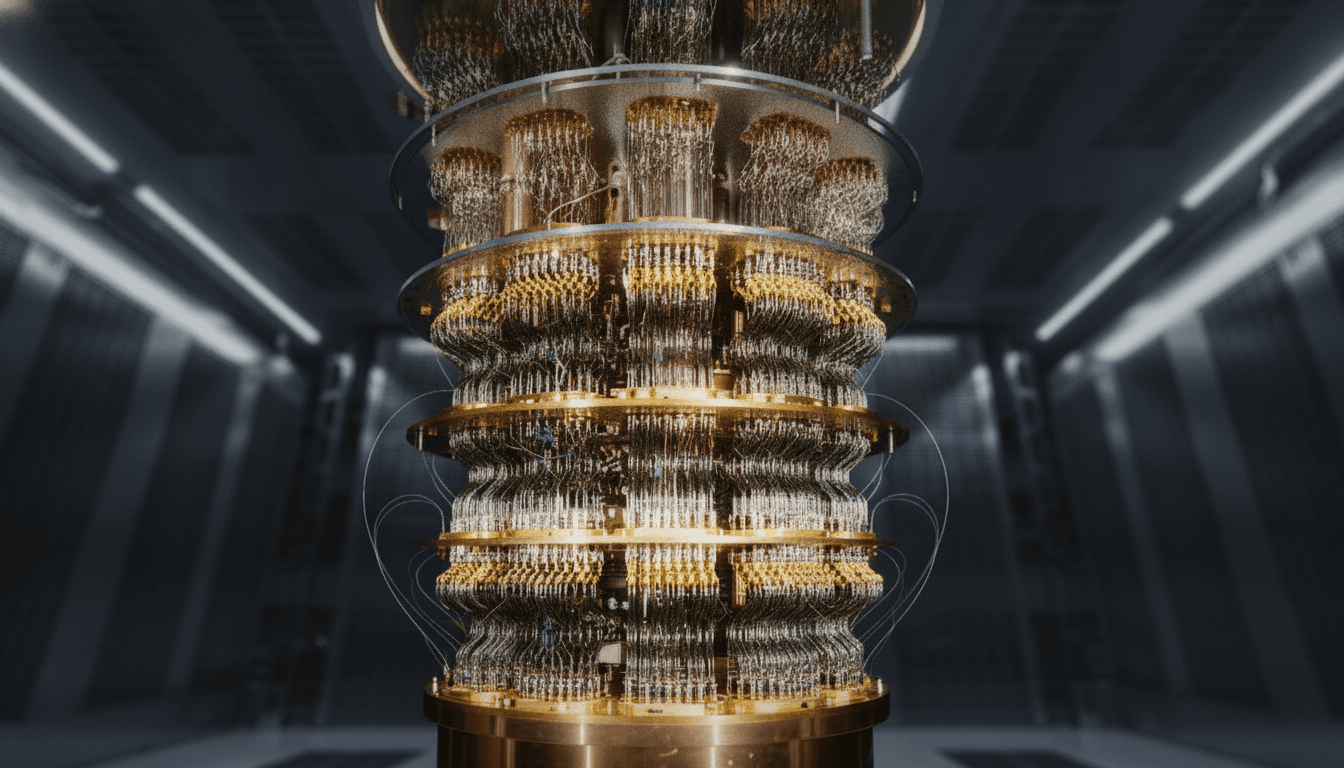
The main villain is a problem called quantum decoherence. A qubit’s delicate superposition state can be shattered by the tiniest disturbance. A stray vibration. A flicker in temperature. The quantum state collapses, the information is lost, and your calculation is ruined. To fight this, today’s quantum computers live inside multi-million-dollar dilution refrigerators—massive, shielded machines that chill the processors to temperatures colder than deep space, just a hair above absolute zero. These insane hurdles are why you access quantum computers via the cloud, sort of like the old mainframe days, as we covered in our explainer on Cloud Computing Explained: The Invisible Engine Running Modern Tech.
Getting past that noise requires serious error correction, which brings its own huge overhead. Some researchers estimate it could take 1,000, or even 10,000, of today's 'noisy' physical qubits just to create a single, stable 'logical qubit.' So, what about breaking modern encryption with Shor's algorithm? That's likely decades away. The cybersecurity world, meanwhile, is already prepping with quantum-resistant encryption. And the geopolitical race is on—a sprint for dominance that looks a lot like the AI and semiconductor showdown detailed in stories like Seoul's Gambit: A Trillion-Dollar Bet on AI and Chip Supremacy.
For the foreseeable future, the most realistic path is a hybrid one. Quantum processors will act as specialized co-processors, the brilliant sidekicks to classical supercomputers. The old machine handles the bulk of the work and outsources the truly impossible quantum bits to the new kid on the block. The finish line is something called “quantum advantage”—that clear, undeniable moment when a quantum computer solves a real-world problem better, faster, or cheaper than any classical rival. That's the milestone the entire industry is racing toward. It's a journey that could unlock breakthroughs that still feel like science fiction, from mapping massive networks as seen in USC's ECHO Algorithm to optimizing entire economies.
So no, you won't be buying a quantum computer at your local electronics store. It’s a long road. Difficult. Expensive. But the work happening right now is laying the foundation for a whole new kind of computation. The prize isn't just a slightly faster computer. It’s a new way to understand the universe itself.
Related Articles

This article was produced with AI assistance under human direction, and reviewed and fact-checked by a named editor before publication. How we work.
Frequently asked questions
- What is quantum computing in simple terms?
- Quantum computing is a new type of computation that uses the principles of quantum mechanics to solve problems too complex for classical computers. Instead of bits (0s and 1s), it uses qubits, which can be a 0, a 1, or both at the same time. This allows them to explore a vast number of possibilities simultaneously, making them ideal for tasks like simulating molecules or solving complex optimization problems.
- Will a quantum computer replace my laptop?
- No, quantum computers are not designed to replace personal computers or smartphones. They are highly specialized machines that excel at very specific tasks, like drug discovery or financial modeling, but are ill-suited for everyday activities like web browsing or email. They require extreme cold and isolation to function, making them accessible primarily through the cloud rather than as consumer devices.
- What are the main uses of quantum computing?
- The most promising near-term quantum computing uses are in fields that handle immense complexity. This includes pharmaceutical research for designing new drugs, materials science for inventing novel materials with desired properties, and finance for optimizing investment portfolios and assessing risk. They are also expected to solve complex logistical problems, such as optimizing global supply chains and delivery routes.
- What is the difference between a bit and a qubit?
- A classical bit is the basic unit of information in computers you use today; it's like a light switch that can only be in one of two states: on (1) or off (0). A qubit, or quantum bit, is the unit for quantum computers. Thanks to a property called superposition, a qubit can be a 1, a 0, or a combination of both simultaneously, which dramatically increases its information-processing capacity.
- How far away is the future of quantum technology?
- While small-scale quantum computers exist today, we are still in the early 'NISQ' (Noisy Intermediate-Scale Quantum) era. These machines are prone to errors and are not yet powerful enough for most commercial applications. Experts believe that achieving 'quantum advantage' for real-world problems is still several years away, and building a large-scale, fault-tolerant quantum computer capable of breaking modern encryption could be a decade or more away.