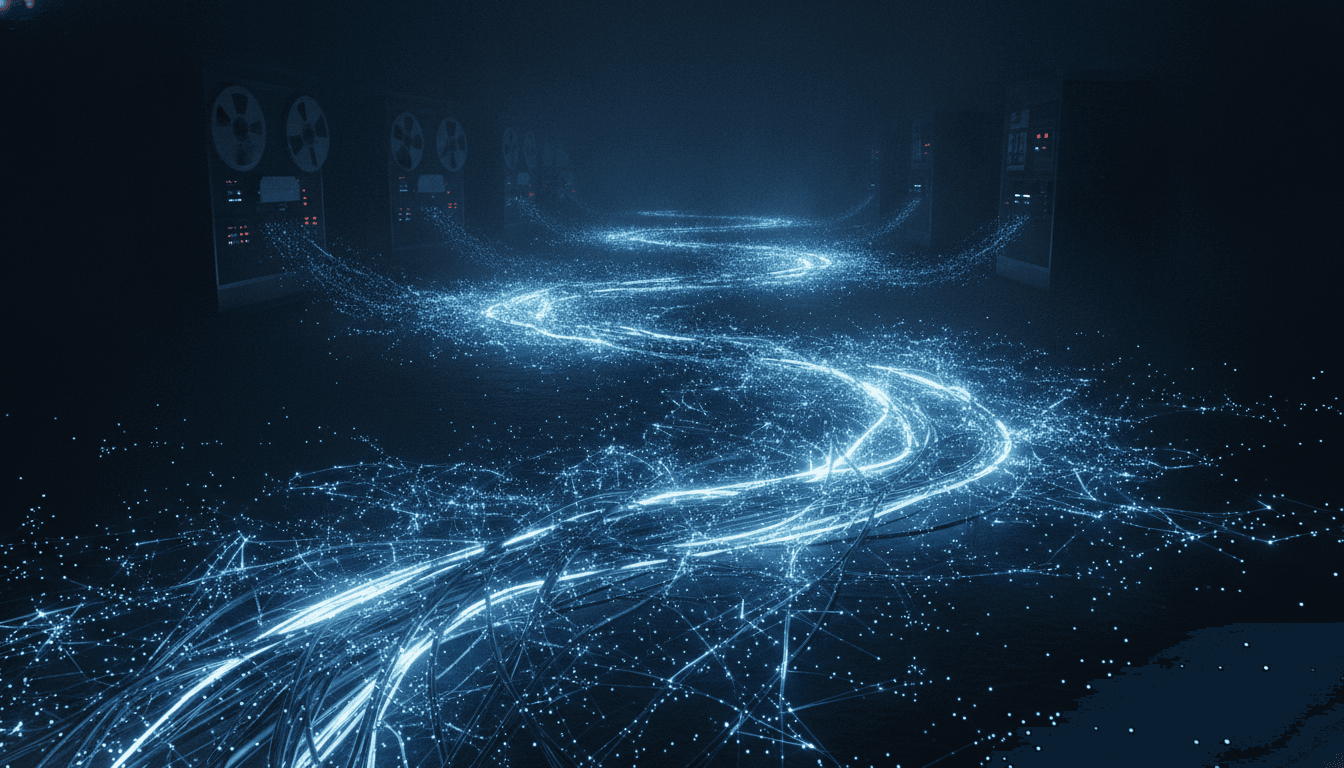
What Is a Transformer Model? The AI Breakthrough Behind ChatGPT
It all goes back to a single 2017 research paper. To understand why AI suddenly got so powerful, you need to understand the simple, brilliant idea of 'attention.'


Explosions don't usually have a birthday. But AI's big bang? It does: June 12, 2017. That's the day eight Google researchers published a paper with a deceptively simple title: "Attention Is All You Need." This paper introduced the world to the transformer. It was a new architecture that completely junked the old, plodding methods of processing language and unleashed the power we now see in tools like ChatGPT and Gemini. If you want to understand the AI boom, you have to understand this one idea.
So, what is a transformer model? It’s a neural network architecture that tore up the rulebook for processing sequential data, like human language. Before the transformer, the reigning champs for language AI were Recurrent Neural Networks, or RNNs. Picture an RNN reading a novel. It plods along, one word at a time, trying desperately to remember the beginning of the chapter by the time it reaches the end. Information was processed step-by-step. Sequentially.
This created two massive problems. First, it was slow. Agonizingly so. The model couldn't calculate the tenth word until it had finished with the ninth, a crippling bottleneck in an age of powerful GPUs built for parallel computing. Second, they had a terrible memory. By the time an RNN got to the end of a long paragraph, it would often 'forget' crucial context from the beginning—a problem called the vanishing gradient. This made understanding nuance almost impossible.
How Transformers Work: Breaking the Sequential Chains
The Google team—Ashish Vaswani, Noam Shazeer, Niki Parmar, Jakob Uszkoreit, Llion Jones, Aidan Gomez, Łukasz Kaiser, and Illia Polosukhin—had a radical thought. What if, instead of reading word-by-word, a model could look at the entire sentence at once? What if it could weigh the importance of every word against every other word, all at the same time?
That’s the essence of the transformer. It ditches the recurrent, sequential approach entirely. By processing all the words in a sequence simultaneously, it could finally exploit the massive parallel processing power of modern hardware. This change alone slashed training times. But the real genius was how it figured out the relationships between all those words.
The Attention Mechanism: It's All About Context
The breakthrough at the heart of the transformer is called the attention mechanism. Or more specifically, 'self-attention.' The idea behind it is surprisingly simple and it mirrors how you comprehend language.
Take this sentence: "The robot picked up the heavy metal ball because it was too heavy to drag."
Easy, right? Your brain instantly knows "it" refers to the "ball," not the "robot." You are, unconsciously, paying more 'attention' to the word "ball" when you process the word "it." Self-attention gives an AI model this exact superpower. As the model considers the word "it," the attention mechanism creates weighted connections to every other word in the sentence, quickly 'learning' that the link to "ball" is incredibly strong and the link to "robot" is weak. This is a core part of what we call machine learning—the system learns these connections by analyzing mountains of text.
This allows the model to build a rich, contextual understanding of language. It can grasp grammar. It can disambiguate words with multiple meanings (like the 'bank' of a river versus a financial 'bank'). And it can trace relationships across huge stretches of text—all things that hobbled the older RNNs. The transformer doesn't just see a line of words; it sees a complex web of interconnected relationships.
Multi-Head Attention: Seeing a Sentence Through Different Lenses
The original paper went a step further, introducing 'multi-head attention.' Think of it like a team of specialists reading the same sentence at the same time, with each one looking for different kinds of connections. One 'head' might focus on grammatical links—the subject and the verb. Another might track how pronouns connect to nouns. A third could identify cause-and-effect. By combining these different perspectives, the model develops a much deeper, more robust understanding of what the text actually means.
The Tech Behind ChatGPT and the Generative AI Boom
The publication of "Attention Is All You Need" did more than just improve machine translation, which was its original focus. It provided the fundamental blueprint for the entire generative AI revolution. It's no accident. The 'T' in ChatGPT stands for Generative Pre-trained Transformer. Models from every major player, from OpenAI's GPT series to Google's Gemini and Anthropic's Claude, are all built on this foundation. Their ability to write essays, generate code, and hold coherent conversations stems directly from the transformer's powerful grasp of context.
This architecture turned out to be incredibly versatile. While born from language, researchers soon adapted it for other uses. Vision Transformers (ViTs) now apply the attention mechanism to patches of an image, letting AI 'see' and interpret visual data with stunning accuracy. The same ideas are powering drug discovery and audio processing. For a deeper look at AI's trajectory, it's worth understanding the long history of AI that led to this moment.
The transformer's secret sauce was its efficiency and scalability. Because transformers could be trained in parallel, labs could just build bigger and bigger models, as publications like WIRED and MIT Technology Review have documented. More data. Bigger models. This scaling is precisely what unlocked the emergent abilities we see in models like OpenAI's latest releases and the impressive benchmarks set by competitors like Anthropic's Claude Opus. The more data the model sees, the better its attention mechanisms get at mapping the patterns of human language.
What started as a clever solution to a machine translation problem became the engine of a new technological era. That 2017 paper didn't just give us a better model. It gave us a new way to think about how machines can understand the world, one weighted connection at a time.
Related Articles



This article was produced with AI assistance under human direction, and reviewed and fact-checked by a named editor before publication. How we work.
Frequently asked questions
- What is a transformer model in simple terms?
- A transformer model is a type of AI architecture that processes entire sequences of data, like a full sentence, all at once. It uses a special technique called 'self-attention' to weigh the importance of each word in relation to all other words, allowing it to understand context and complex relationships much more effectively than older models that processed words one-by-one.
- Why are transformer models better than RNNs?
- Transformers are superior to older models like Recurrent Neural Networks (RNNs) for two main reasons. First, they process data in parallel, not sequentially, which makes training them dramatically faster on modern hardware. Second, their attention mechanism allows them to effectively track long-range dependencies and context in text, overcoming the 'short memory' problem that limited RNNs.
- What is the 'attention mechanism' in AI?
- The attention mechanism lets an AI model focus on the most relevant parts of its input data when making a decision. In the context of language, as it processes one word, it gives an 'attention score' to all other words in the sentence. This helps it understand that in the phrase 'the tired robot and the heavy ball, it...', the word 'it' most likely refers to the 'ball,' not the 'robot.'
- Is ChatGPT a transformer model?
- Yes, ChatGPT is built upon the transformer architecture. The 'T' in GPT actually stands for Transformer (Generative Pre-trained Transformer). This architecture, introduced in a 2017 Google paper, is the foundational technology behind almost all modern large language models, including Google's Gemini and Anthropic's Claude.
- Who invented the transformer model?
- The transformer model was introduced in a 2017 research paper titled "Attention Is All You Need." It was authored by a team of eight researchers then working at Google: Ashish Vaswani, Noam Shazeer, Niki Parmar, Jakob Uszkoreit, Llion Jones, Aidan Gomez, Łukasz Kaiser, and Illia Polosukhin. Their work completely changed the field of artificial intelligence.
Sources & further reading
Sources
- wikipedia.org — en.wikipedia.org
- arxiv.org — arxiv.org
- isi.edu — isi.edu
- parseur.com — parseur.com
- nd.edu — pls.nd.edu
- medium.com — medium.com