SpaceX Launches First Commercial Nuclear-Powered Satellite
A softball-sized CubeSat with a nuclear heart just rode a Falcon 9 to orbit, kicking off a new era of persistent, solar-independent power for commercial space.
 AI Tech Dialogue Editorial Team6 min read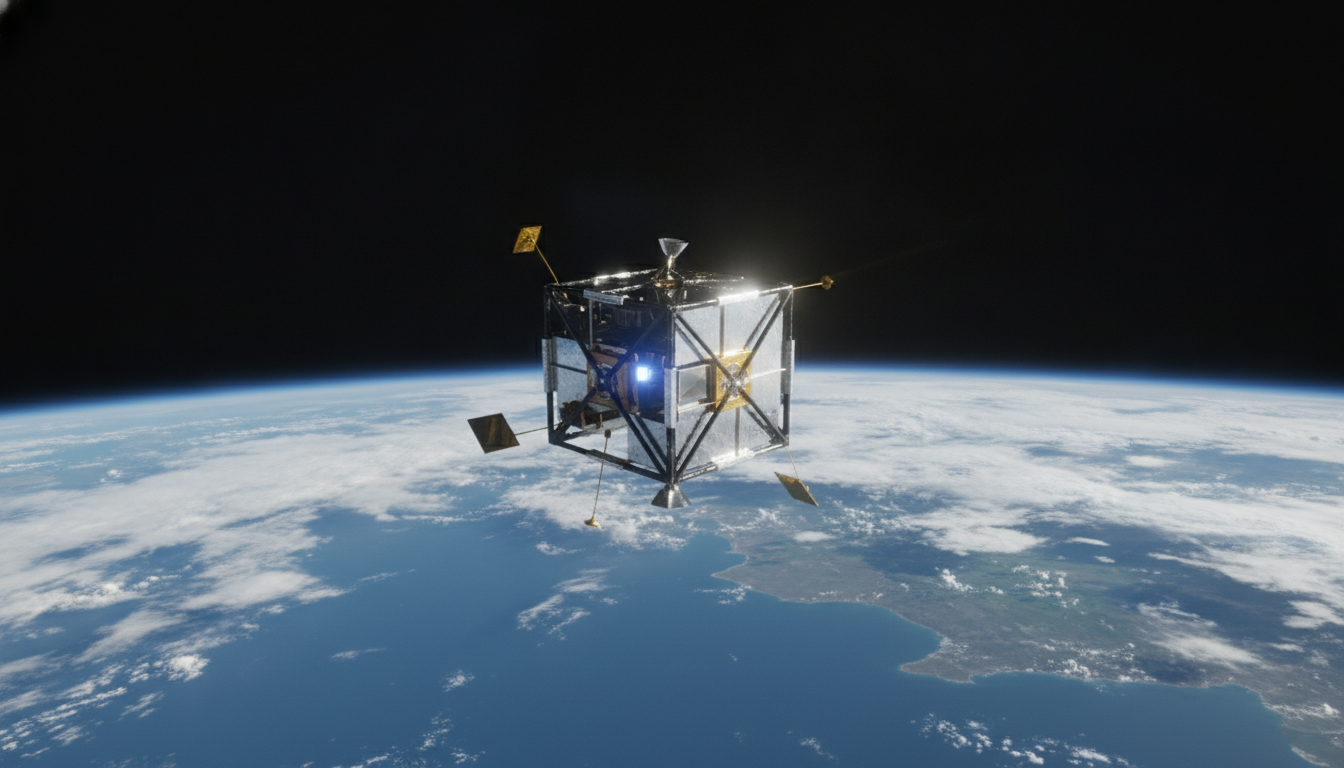
A New Atomic Dawn in Orbit
Commercial space just went nuclear. On July 7, a SpaceX Falcon 9 rocket blasted off from California's Vandenberg Space Force Base, hauling 81 different payloads on its Transporter-17 rideshare mission. But tucked inside was a trailblazer. Its name is BOHR, and it's the world's first commercial nuclear-powered satellite. The little softball-sized CubeSat, developed by Florida-based City Labs, signals a quiet but seismic shift in how we power our ambitions beyond Earth.
But this isn't a nuclear reactor in the way you might think. No fission. No intense heat. Instead, the BOHR mission is a testbed for City Labs' proprietary NanoTritium™ battery. It’s a betavoltaic device that generates a steady, low-level electric current directly from the radioactive decay of tritium, an isotope of hydrogen. Here's the catch: it's a technology that could unchain satellites from the sun, potentially powering missions for over 20 years with zero maintenance.
"This is a historic step for commercial nuclear power in space," said Peter Cabauy, CEO of City Labs, in a statement after the launch. "BOHR demonstrates that safe, compact, and regulatory-approved nuclear power systems are ready for routine commercial deployment. This capability enables persistent, always-on payload operations that are not constrained by sunlight or battery life."
How Betavoltaics Are Rewriting the Rules of Space Power
For decades, the satellite industry has relied on a simple formula: giant solar arrays charging chemical batteries. It's a proven system. But it has serious weaknesses. Solar power is useless in the dark—whether that's a planet's shadow, a deep lunar crater, or the dim outer reaches of the solar system. And batteries degrade, killing missions. While the BOHR satellite itself still uses solar panels for its main operations, its real job is to validate the nuclear payload inside. A crucial first step.
Betavoltaic tech works more like a solar cell than a reactor. As tritium inside the NanoTritium battery decays, it spits out beta particles (high-energy electrons). A semiconductor material simply captures these particles, converting their energy directly into a continuous electrical current. The process is non-thermal, incredibly reliable, and produces just nanowatts to microwatts of power. Not enough to run a city, obviously, but absolutely perfect for the low-power, high-reliability sensors and microelectronics that are the backbone of modern space systems. And with a half-life of 12.3 years, tritium provides a predictable power source for decades.
What could this kind of persistent, independent power unlock? Imagine sensor networks on the Moon that never sleep, even during the two-week lunar night. Think of deep-space probes operating critical systems for decades, far from the sun's fading light. For complex future systems, from lunar bases to the onboard processing needed for Artificial General Intelligence in autonomous probes, reliable long-term power isn't a luxury. It's everything.
Navigating the Final Frontier: Regulation
The technology is one thing. The paperwork is another. The regulatory path City Labs forged is almost as significant as the battery itself. The BOHR mission is the first commercial nuclear project to ever successfully get through the approval gauntlet established by the Federal Aviation Administration (FAA) under the 2019 National Security Presidential Memorandum-20. After a safety review supported by Sandia National Laboratories, the company got its payload authorization in September 2025. This sets a vital precedent.
And that’s a huge deal. NASA has used radioisotope power sources for decades on legendary missions like Voyager. But for commercial companies? Access has been basically non-existent. By proving a clear, repeatable regulatory pathway, City Labs didn't just launch a satellite; it kicked open the door to a new market. "The innovation here is not just in the technology. It's in the regulatory part," Cabauy told Payload magazine.
What's Next for the Nuclear Space Age?
The BOHR CubeSat will probably stay in orbit for about 10 years. But we won't have to wait that long for answers. City Labs expects to get definitive results from its payload demonstration within just weeks or months. Success would mean the NanoTritium battery has stood up to the brutal environment of space—the vacuum, the radiation, the wild temperature swings—all conditions where ordinary batteries simply fail.
The ripple effects go far beyond this one tiny satellite. With NASA's Artemis program aiming for a permanent base in the Moon's perpetually dark southern regions, the demand for non-solar power is exploding. City Labs' technology is now the first commercial solution to that very problem. The U.S. Air Force and NASA are already on board, giving the company grants to develop micropowered sensors to hunt for water ice in those same lunar craters. The potential here feels as foundational as the early work that's now leading to things like penny-sized quantum computers.
From medical implants to remote sensors here on Earth, betavoltaic power is no longer theoretical. It's in orbit. Right now. It's quietly generating a current that could energize the entire next generation of space exploration and commerce. The nuclear age of commercial space has arrived, not with a bang, but with the steady glow of decaying tritium.
Frequently asked questions
- What is the first commercial nuclear-powered satellite?
- The first commercial nuclear-powered satellite is the Betavoltaic Orbital High-Reliability (BOHR) CubeSat, developed by City Labs. It was launched on July 7, 2026, aboard a SpaceX Falcon 9 rocket as part of the Transporter-17 rideshare mission. The mission's goal is to demonstrate the viability of its nuclear battery technology in orbit.
- How does the City Labs nuclear satellite work?
- The satellite uses a NanoTritium™ betavoltaic battery. This device harnesses the natural radioactive decay of tritium, a hydrogen isotope. As tritium decays, it emits beta particles (electrons), which are captured by a semiconductor material and converted directly into a continuous electrical current. It is a non-thermal process, different from traditional nuclear reactors.
- Why is a nuclear-powered satellite a big deal?
- It marks a major step towards freeing spacecraft from reliance on solar power. Nuclear batteries, like City Labs' NanoTritium device, can provide continuous power for over 20 years, regardless of sunlight. This enables longer and more complex missions in deep space or in permanently shadowed regions of the Moon, where solar panels are ineffective.
- Is the nuclear satellite safe?
- Yes, the technology is considered safe. The battery uses tritium, which emits low-energy beta particles that are easily shielded. The device is solid-state and does not emit dangerous radiation externally. Furthermore, the BOHR mission was the first to complete the Federal Aviation Administration's rigorous safety and regulatory approval process for commercial nuclear launches.
Sources & further reading
Sources
- US Company Launches First Commercial Nuclear Satellite on SpaceX Mission — NucNet
- space.com — space.com
- thenextweb.com — thenextweb.com
- ans.org — ans.org
- citylabs.net — citylabs.net
Further reading
- 01
 Science
Magnetic Wave Lifetime Jumps 100x, Hinting at Penny-Sized Quantum Computers
- 02
 Science
The Real Science of Aging: What Actually Works for Living Longer
- 03
 Science
Our Silent Engine: The Ocean Runs the Planet. We're Breaking It.
- 04
 Science
How Are Vaccines Actually Made? A Look Inside the Science
- 05
 Science
The Science of Habit Formation: Why Willpower Is Not the Answer